Dose-Response Effects of Digestible Methionine Plus Cystine on Hepatic-Ovarian Gene Expression, Endocrine Markers, and Redox Status in Post-Molt Laying Hens
Keywords:
Sulfur amino acids; post-molt laying hen; Hepatic–ovarian axis; Nutrigenomics; Yolk precursorAbstract
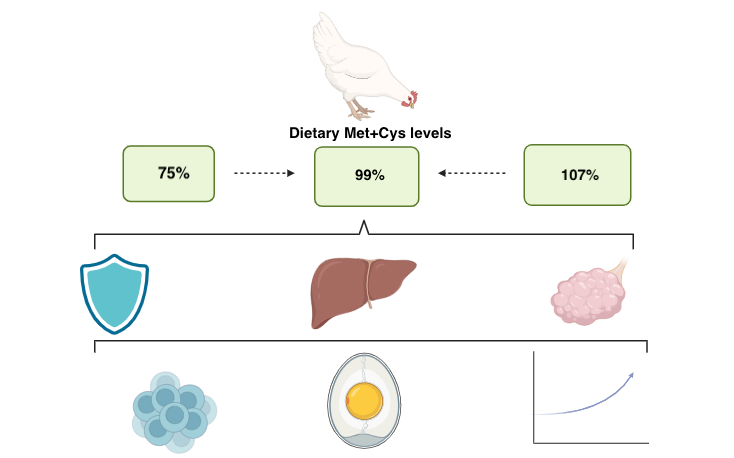
This study investigated the effects of graded dietary digestible methionine plus cystine (dMC) on hepatic and ovarian gene expression, reproductive hormones, and antioxidant status in post-molt Hy-Line W-80 laying hens (79 to 95 weeks of age; n = 180). Hens were randomly allocated to five isonitrogenous and isoenergetic diets providing dMC: Lys ratios of 75, 83, 91, 99, and 107 (dMC75 to dMC107), corresponding to dMC levels of 0.490% to 0.698%. Hepatic mRNA expression of yolk precursor genes (VTG1, VTG3, VLDLR), apolipoproteins (APOA1, APOA4), and lipogenic enzymes (DGAT2, LPIN1) showed quadratic responses, with maximal expression at dMC99. Ovarian mRNA expression of growth factors (IGF1, IGF1R, BMP6), folliculogenesis markers (AMH, INHA, INHBA), angiogenic factors (VEGFA, KDR), and transcription factors (GATA4, FOXL2) followed similar quadratic patterns, peaking at dMC99. Circulating estradiol, progesterone, insulin-like growth factor-1, and anti-Müllerian hormone exhibited significant quadratic responses, with peak values generally observed at dMC99. Malondialdehyde decreased from 6.49 to 3.55 nmol/mL, while total antioxidant capacity increased from 1.11 to 1.77 mmol/L, and catalase activity rose from 44.62 to 78.32 U/mL. Principal component analysis separated treatments along PC1 (54.9% variance), with dMC99 clustering with favorable parameters. Strong positive correlations were observed among estradiol-17β, catalase, anti-Müllerian hormone, and lipid metabolites (r = 0.78 to 0.92). These results suggest that dietary sulfur amino acid supply is associated with quadratic regulation of the hepatic-ovarian axis in post-molt laying hens, with optimal effects observed at approximately 0.648% dMC (dMC: Lys = 99).
Downloads

Published
Issue
Section
License
Copyright (c) 2026 Amir Ahmadpour, Mousa Zarrin (Corresponding Author)

This work is licensed under a Creative Commons Attribution-NonCommercial 4.0 International License.