μ-Opioid Receptor Blockade Potentiates NPW23-Induced Hyperphagia in Neonatal Broiler Chicks
Keywords:
Opioid receptor, Food intake, Broiler chicken, Hyperphagia, Neuropeptide WAbstract
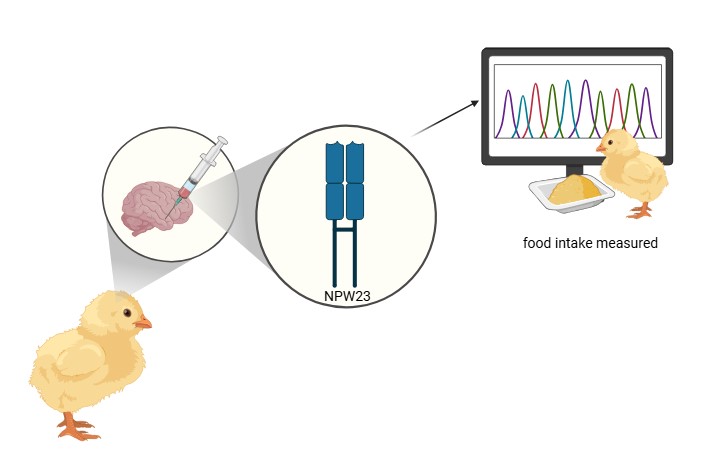
Neuropeptide W (NPW) is an endogenous ligand for GPR7 and GPR8 receptors and has recently been identified as an orexigenic factor in birds. However, the involvement of the central opioidergic system in NPW-induced feeding has not been investigated. This study aimed to determine the role of μ-, δ-, and κ-opioid receptors in hyperphagia elicited by intracerebroventricular (ICV) injection of NPW23 in neonatal broiler chicks. A total of 176 male chicks (Ross 308 strain), aged 24 hours post‑hatching, were utilized as experimental subjects across four distinct investigations. In Experiment 1, chicks received ICV injections of control solution or NPW23 (0.75, 1.5, and 3 nmol) to establish a dose-response curve. In the second experiment, subjects received injections of either a control vehicle, NPW23 at a dosage of 3 nanomoles, β-funaltrexamine (β-FNA; a selective μ-opioid receptor antagonist), or a combination of NPW23 and β-FNA. The third experimental trial employed naltrindole (NTI; a δ-opioid receptor antagonist), whereas the fourth investigation utilized nor-binaltorphimine (nor-BNI; a κ-opioid receptor antagonist). Following treatment administration, cumulative feed consumption was measured at 30, 60, and 120 minutes post-injection and subsequently normalized to each subject’s body weight. NPW23 at 1.5 and 3 nmol dose-dependently increased food intake at all time points (P < 0.05). Co-administration of β-FNA with NPW23 significantly potentiated NPW23-induced hyperphagia (P < 0.05). In contrast, co-injection of NTI or nor-BNI with NPW23 did not alter the orexigenic response (P ≥ 0.05). These findings indicate that μ-opioid receptor blockade potentiates NPW23-induced feeding, suggesting that central μ-opioid receptor signaling may exert an inhibitory modulatory influence on NPW23-induced hyperphagia in neonatal broiler chicks.
Downloads

Published
Issue
Section
License
Copyright (c) 2026 Hamed Zarei (Corresponding Author); Morteza Zendehdel, Rozhin Fazel , Keyvan Hasani (Author)

This work is licensed under a Creative Commons Attribution-NonCommercial 4.0 International License.