Comparative Serological Effectiveness of Newcastle Disease Vaccines and Vaccination Regimens on Commercial Broilers: A Multisite Study in Iran
Keywords:
Antibody response, Broilers, Immunity, Newcastle disease, Vaccination regimenAbstract
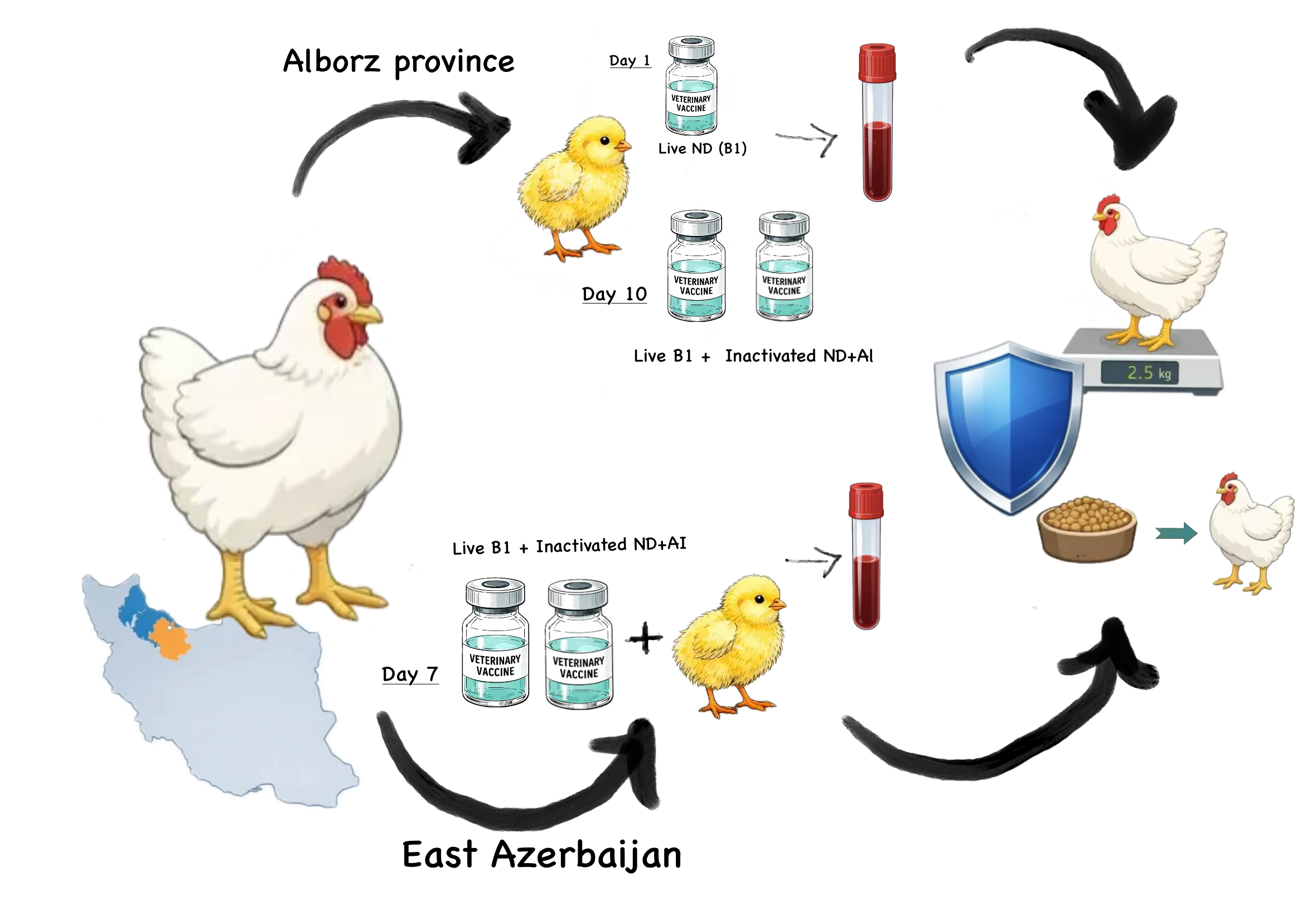
Newcastle disease (ND) is a worldwide viral disease that imposes major economic losses on the poultry industry due to the vast vaccination and catastrophic death after infection, especially in broilers. This study aimed to compare the serological effectiveness of ND vaccines produced by the Razi Vaccine and Serum Research Institute with three imported vaccines and to evaluate the impact of two vaccination regimens on broilers. Two commercial farms with four houses in each in Alborz and East Azerbaijan provinces were randomly assigned to receive one of four ND vaccine brands (V1, V2, V3, and Razi). In Alborz, flocks were vaccinated with ND B1 at 1, 10, and 36 days of age (DOA), plus an inactivated bivalent ND+AI vaccine at 10 DOA (each house had the same regime but a different vaccine brand). In East Azerbaijan, the vaccination regimen included ND B1 combined with the ND+AI vaccine at 7 DOA, followed by ND LaSota and ND B1 at 20 and 29 DOA, respectively. Seroconversion against ND was measured at 1, 21, and 42 DOA by hemagglutination inhibition (HI) assay. In Alborz, the proportion of protected birds (HI ≥ 4) varied significantly at 21 DOA (80%, 50%, 60%, and 75% for V1, V2, V3, and Razi, respectively; P < 0.05). By 42 DOA, neither mean titers nor protection rates differed significantly among groups (P > 0.05). In East Azerbaijan, at 21 DOA, the V1 and Razi groups had the highest proportion of birds with protective titers. By 42 DOA, groups V1 and Razi exhibited significantly higher titers compared to V2 (P < 0.05). The East Azerbaijan program yielded suboptimal antibody responses during the critical 3-week period, followed by higher titers at later ages, possibly due to stronger immune system booster by the LaSota strain. In contrast, the Alborz regimen stimulated an earlier serological response, but not significantly different from the Azerbaijan experiment (P>0.05), providing more reliable early protection. In conclusion, in spite of some differences in antibody responses at 21 DOA , particularly with V1 and the domestic vaccine (Razi), with higher proportions of protected birds, these differences diminished by 42 DOA, indicating that all evaluated vaccines were ultimately capable of inducing protective immunity.
Downloads

Downloads
Published
Issue
Section
License
Copyright (c) 2026 Alireza Yousefi (Author); Mohammad Abdoshah (Corresponding Author); Najmeh Motamed, Fouad Al-Masri (Author)

This work is licensed under a Creative Commons Attribution-NonCommercial 4.0 International License.