Detection and evaluation of antibiotic-resistant Escherichia coli strains in birds of prey from the Kerman Province, Iran
Keywords:
Raptor, E. coli O157, PCR, Antimicrobial resistance (AMR), Kerman provinceAbstract
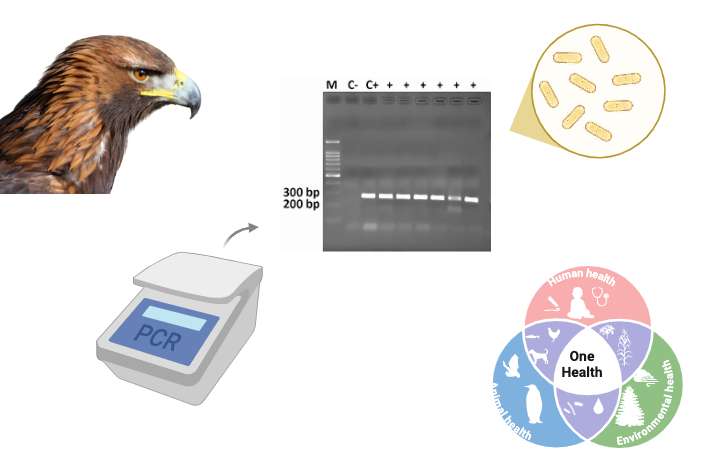
Raptors play an important role in the ecosystem as top predators. They can transmit diseases over long distances, affecting the environment, humans, and animals, in line with the one-health approach. Identifying their infectious agents helps to understand existing and emerging diseases. Escherichia coli infection, one of the most common bacterial diseases of poultry, causes significant economic losses, and its increasing antibiotic resistance highlights the need for drug susceptibility testing. In this study, the identification and investigation of antibiotic resistance of E. coli strains, especially E. coli O157, in 33 raptors that act as carriers of this pathogenic bacterium were investigated. For this purpose, 66 swab samples were collected: 33 from the choanal cleft and 33 from the cloaca. Through culture, biochemical testing, and PCR, 48 E. coli isolates, including 16 E. coli O157 isolates, were identified. Escherichia coli isolates were then evaluated for susceptibility to six different antibiotics. Among the 48 E. coli-positive samples, the greatest resistance was observed to colistin and neomycin, with sulfamethoxazole and trimethoprim, enrofloxacin, Linco-Spectin (lincomycin hydrochloride and spectinomycin sulfate tetrahydrate), and chloramphenicol showing lesser but still moderate resistance. Given the isolation of E. coli (O157) strains from raptors in Kerman province and their observed antibiotic resistance, treatment options are significantly limited. Given the raptors' ability to migrate and travel long distances, these resistant and pathogenic bacteria can be transmitted to humans and domestic animals. Therefore, based on the one-health approach, monitoring, studying, and treating infected raptors in captive environments are particularly important for controlling E. coli disease in the context of interactions among animals, humans, and the ecosystem. Further research across broader areas of Iran is essential to identify and manage this disease.
Downloads
References
Ford SR. Raptor Gastroenterology. J Exot Pet Med. 2010;19(2):140-50. doi: 10.1053/j.jepm.2010.05.004.
Gargiulo A, Fioretti A, Russo TP, Varriale L, Rampa L, Paone S, et al. Occurrence of enteropathogenic bacteria in birds of prey in Italy. Lett Appl Microbiol. 2018;66(3):202-6. doi: 10.1111/lam.12836.
Blomqvist M, Christerson L, Waldenström J, Lindberg P, Helander B, Gunnarsson G, et al. Chlamydia psittaci in birds of prey in Sweden. Infect Ecol Epidemiol. 2012;2(1):8435. doi: 10.3402/iee.v2i0.8435.
Ewing WH, Edwards PR. Edwards and Ewing's identification of Enterobacteriaceae: New York: Elsevier; 1986.
Dho-Moulin M, Fairbrother JM. Avian pathogenic Escherichia coli (APEC). Vet Res. 1999;30(2-3):299-316.
Callaway TR, Edrington TS, Nisbet DJ. Isolation of Escherichia coli O157:H7 and Salmonella from migratory brown-headed cowbirds (Molothrus ater), common grackles (Quiscalus quiscula), and cattle egrets (Bubulcus ibis). Foodborne Pathog Dis. 2014;11(10):791-4. doi: 10.1089/fpd.2014.1800.
Rangel JM, Sparling PH, Crowe C, Griffin PM, Swerdlow DL. Epidemiology of Escherichia coli O157:H7 outbreaks, United States, 1982-2002. Emerg Infect Dis. 2005;11(4):603-9. doi: 10.3201/eid1104.040739.
Immunology H, Disease A. The effects of berberine on the magnitude of the acute inflammatory response induced by Escherichia coli lipopolysaccharide in broiler chickens. Poult Sci. 2010;89:13-9. doi: 10.3382/ps.2009-00243.
McPeake SJW, Smyth JA, Ball HJ. Characterisation of avian pathogenic Escherichia coli (APEC) associated with colisepticaemia compared to faecal isolates from healthy birds. Vet Microbiol. 2005;110(3-4):245-53. doi: 10.1016/j.vetmic.2005.08.001.
Radhouani H, Poeta P, Gonçalves A, Pacheco R, Sargo R, Igrejas G. Wild birds as biological indicators of environmental pollution: Antimicrobial resistance patterns of Escherichia coli and Enterococci isolated from common buzzards (Buteo buteo). J Med Microbiol. 2012;61(6):837-43. doi: 10.1099/jmm.0.038364-0.
Stromberg ZR, Johnson JR, Fairbrother JM, Kilbourne J, Van Goor A, Curtiss R, et al. Evaluation of Escherichia coli isolates from healthy chickens to determine their potential risk to poultry and human health. PLoS One. 2017;12(7):e0180599. doi: 10.1371/journal.pone.0180599.
Pormohammad A, Nasiri MJ, Azimi T. Prevalence of antibiotic resistance in Escherichia coli strains simultaneously isolated from humans, animals, food, and the environment: a systematic review and meta-analysis. Infect Drug Resist. 2019;12:1181. doi: 10.2147/IDR.S201324.
Jurado-Tarifa E, Torralbo A, Borge C, Cerdà-Cuéllar M, Ayats T, Carbonero A, et al. Genetic diversity and antimicrobial resistance of Campylobacter and Salmonella strains isolated from decoys and raptors. Comp Immunol Microbiol Infect Dis. 2016;48:14-21. doi: 10.1016/j.cimid.2016.07.003.
Markey B, Maguire D, Leonard F, Archambault A, Cullinane A. Clinical Veterinary Microbiology: [Publisher not specified]; 2013.
Washington JA. Laboratory Procedures in Clinical Microbiology: [Publisher not specified]; 1985.
Paton AW, Paton JC. Detection and characterization of Shiga toxigenic Escherichia coli by using multiplex PCR assays for stx1, stx2, eaeA, enterohemorrhagic E. coli hlyA, rfbO111, and rfbO157. J Clin Microbiol. 1998;36(2):598-602. doi: 10.1128/JCM.36.2.598-602.1998.
Lubbers BV, Papich MG, Schwarz S, Bowden R, Dubraska BS, Diaz-Campos V. Performance Standards for Antimicrobial Disk and Dilution Susceptibility Tests for Bacteria Isolated From Animals: A CLSI Supplement for Global Application: [Publisher not specified]; 2018.
M. Performance Standards for Antimicrobial Susceptibility Testing: A CLSI Supplement for Global Application: [Publisher not specified]; 2024.
Pierce VM, Mathers AJ. Setting Antimicrobial Susceptibility Testing Breakpoints: A Primer for Pediatric Infectious Diseases Specialists on the Clinical and Laboratory Standards Institute Approach. J Pediatric Infect Dis Soc. 2022;11(2):73-80. doi: 10.1093/jpids/piab106.
Hammerum AM, Heuer OE. Human health hazards from antimicrobial-resistant Escherichia coli of animal origin. Clin Infect Dis. 2009;48(7):916-21. doi: 10.1086/597292.
Bertelloni F, Lunardo E, Rocchigiani G, Ceccherelli R, Ebani V. Occurrence of Escherichia coli virulence genes in feces of wild birds from Central Italy. Asian Pac J Trop Med. 2019;12(3):142-6. doi: 10.4103/1995-7645.254941.
Mousavinezhad M, Sharifmoghadam MR, Aliabadian M, Bahreini M, Waldenström J. Pathogenic bacteria and the prevalence of virulence genes in E. coli isolated from passerine birds of Iran. Iran J Anim Biosyst. 2024;20(1):11-22.
Nandhini B, S S, B S. A Study On The Prevalence Of Potential Zoonotic Bacterial Pathogens Among Household And Pet Shop Pigeons And Their Emergence Of Multidrug Resistant Strains, In And Around The Longwood, The Nilgiris. African Journal of Biomedical Research. 2024;27(1S):216-28. doi: 10.53555/AJBR.v27i1S.1405.
Diren Sigirci B, Celik B, Halac B, Adiguzel MC, Kekec I, Metiner K. Antimicrobial resistance profiles of Escherichia coli isolated from companion birds. J King Saud Univ Sci. 2020;32(1):1069-73. doi: 10.1016/j.jksus.2019.09.014.
Nolan LK, John BH, Vaillancourt JP, Abdul-Aziz T, Logue CM. Colibacillosis
Diseases of Poultry: Thirteenth Edition2017. 751-805 p.
Mousavi R, Rahimi E, Shakerian A. Incidence and Profiles of Antibiotic Resistance and Virulence Markers of The Escherichia coli O157 Bacteria Recovered From Poultry Meat. Egyptian Journal of Veterinary Sciences. 2020;51(2):215-23. doi: 10.21608/ejvs.2020.20516.1141.
Guenther S, Grobbel M, Lübke-Becker A, Goedecke A, Friedrich ND, Wieler LH. Antimicrobial resistance profiles of Escherichia coli from common European wild bird species. Vet Microbiol. 2010;144(1-2):219-25. doi: 10.1016/j.vetmic.2009.12.016.
Vredenburg J, Varela AR, Hasan B, Bertilsson S, Olsen B, Narciso-da-Rocha C. Quinolone-resistant Escherichia coli isolated from birds of prey in Portugal are genetically distinct from those isolated from water environments and gulls in Portugal, Spain and Sweden. Environ Microbiol. 2014;16(4):995-1004. doi: 10.1111/1462-2920.12231.
Varriale L, Dipineto L, Russo TP, Borrelli L, Romano V, D'Orazio S. Antimicrobial resistance of Escherichia coli and Pseudomonas aeruginosa from companion birds. Antibiotics. 2020;9(11):1-7. doi: 10.3390/antibiotics9110780.
Şahan Yapicier O, Hesna Kandir E, Öztürk D. Antimicrobial Resistance of E. coli and Salmonella Isolated from Wild Birds in a Rehabilitation Center in Turkey. Arch Razi Inst. 2022;77(1):257.
Jackson A, Beleza F, Maciel WC, Carreira AS, Marques AR, Henrique C, et al. Wild birds as reservoirs of multidrug-resistant enterobacteria in Mulungu, Brazil. [Journal not specified]. 2021;2:1-29.
Azizpour A. Determination of Antibiotic Resistance Patterns of Escherichia Coli Strains to Twenty Antibiotics Used in Iran. Journal of Sabzevar University of Medical Sciences. 2022;29(1):101-14.
Hardiati A, Safika S, Wibawan IWT, Indrawati A, Pasaribu FH. Isolation and detection of antibiotics resistance genes of Escherichia coli from broiler farms in Sukabumi, Indonesia. J Adv Vet Anim Res. 2021;8(1):84. doi: 10.5455/javar.2021.h489.
Salehi M, Ghanbarpour R. Characterization of Escherichia coli Isolates from Commercial Layer Hens with Salpingitis. Am J Anim Vet Sci. 2010;5(3):208-14. doi: 10.3844/ajavsp.2010.208.214.
Sepehri G. Prevalence of Bacterial Resistance to Commonly Used Antimicrobials among Escherichia coli Isolated from Chickens in Kerman Province of Iran. Journal of Medical Sciences. 2006;[Volume not specified].

Downloads
Published
Submitted
Revised
Accepted
Issue
Section
License
Copyright (c) 2024 Mostafa Zangiabadi, Maziar Jajarmi Jajarmi, hemad shafiei, Hadi Tavakkoli, Sara Amrollahi (Author)

This work is licensed under a Creative Commons Attribution-NonCommercial 4.0 International License.