Artificial Intelligence Applications in Poultry Health and Welfare Monitoring: A Systematic Review and Meta-analysis of Model Performance
Keywords:
Artificial intelligence, Machine learning, Poultry, Welfare, Health monitoring, Precision livestock farmingAbstract
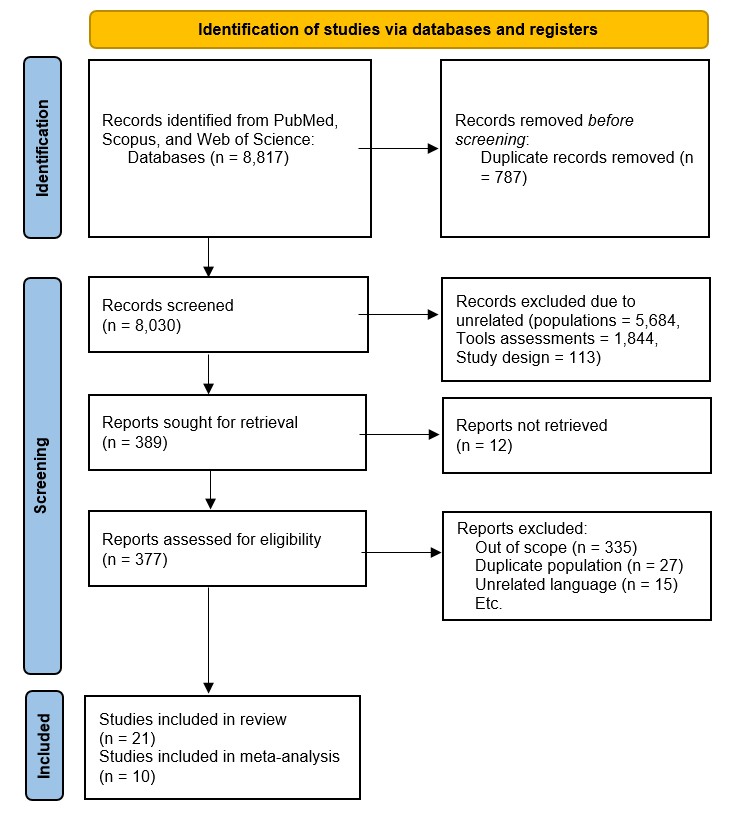
Artificial intelligence (AI), machine learning, computer vision, sensor-based systems, and Internet of Things (IoT) technologies are increasingly used for automated monitoring of poultry health and welfare, but reported model performance varies across tasks, data sources, validation strategies, and production settings. This systematic review and meta-analysis evaluated the reported performance of AI-based models for poultry health and welfare monitoring. PubMed/MEDLINE, Scopus, and Web of Science were searched for peer-reviewed studies involving poultry, reporting health- or welfare-related monitoring outcomes, and providing extractable model-performance data. Data were extracted independently by two reviewers, and pooled accuracy was estimated using a Restricted Maximum Likelihood random-effects model in STATA version 17. Twenty-one studies published between 2012 and 2025 were included, of which ten were eligible for meta-analysis. Included systems used convolutional neural networks, random forests, support vector machines, and other machine-learning approaches for behavior recognition, disease detection, lesion assessment, mortality detection, environmental monitoring, and welfare assessment. The pooled accuracy estimate was 90.39% (95% CI: 84.89–95.89; p<0.001), with substantial heterogeneity among studies. Reported performance varied by application domain, data source, model type, assessment dimension, sample size, and integration with IoT-based systems. AI-based technologies show promise for automated poultry health and welfare monitoring; however, heterogeneous methods and limited external validation restrict the generalizability of pooled estimates. Future studies should prioritize standardized reporting, open datasets, external validation, and testing under commercial farm conditions.
Downloads
References
Abdel-Wareth, A. A., Ahmed, A., Salahuddin, M., & Lohakare, J. (2025). Application of Artificial Intelligence in Rabbit Husbandry: From Reproductive Moni-toring to Precision Farming. Frontiers in Veterinary Science, 12, 1679630.
Attia, Y. A., Aldhalmi, A. K., Youssef, I. M., Bovera, F., Tufarelli, V., El-Hack, M. E. A., El-Kholy, K. H., & Shukry, M. (2024). Climate change and its effects on poultry industry and sustainability. Discover Sustainability, 5(1), 397. https://doi.org/10.1007/s43621-024-00627-2
Aydin, A. (2017). Using 3D vision camera system to automatically assess the level of inactivity in broiler chickens. Computers and Electronics in Agriculture, 135, 4-10.
Bao, Y., Lu, H., Zhao, Q., Yang, Z., Xu, W., & Bao, Y. (2021). Detection system of dead and sick chickens in large scale farms based on artificial intelligence. Math. Biosci. Eng, 18(5), 6117-6135.
Bhattad, S., Ahmed, A. A., Abdel-Wareth, A. A. A., & Lohakare, J. (2025). An IoT-Based System for Measuring Diurnal Gas Emissions of Laying Hens in Smart Poultry Farms. AgriEngineering, 7(8), 267. https://www.mdpi.com/2624-7402/7/8/267
Castro Júnior, S. L. d., da Silva, I. J., Nazareno, A. C., & Mota, M. d. O. (2022). Computer vision for morphometric evaluation of broiler chicken bones. Engenharia Agrícola, 42, e20210150.
Cruz, E., Hidalgo-Rodriguez, M., Acosta-Reyes, A. M., Rangel, J. C., Boniche, K., & Gonzalez-Olivardia, F. (2025). ACMSPT: Automated Counting and Monitoring System for Poultry Tracking. AgriEngineering, 7(3), 86. https://www.mdpi.com/2624-7402/7/3/86
De Montis, A., Pinna, A., Barra, M., & Vranken, E. (2013). Analysis of poultry eating and drinking behavior by software eYeNamic. Journal of Agricultural Engineering, 44(s2).
Degu, M. Z., & Simegn, G. L. (2023). Smartphone based detection and classification of poultry diseases from chicken fecal images using deep learning techniques. Smart Agricultural Technology, 4, 100221.
Du, X., Carpentier, L., Teng, G., Liu, M., Wang, C., & Norton, T. (2020). Assessment of laying hens’ thermal comfort using sound technology. Sensors, 20(2), 473.
Elmessery, W. M., Gutiérrez, J., Abd El-Wahhab, G. G., Elkhaiat, I. A., El-Soaly, I. S., Alhag, S. K., Al-Shuraym, L. A., Akela, M. A., Moghanm, F. S., & Abdelshafie, M. F. (2023). YOLO-based model for automatic detection of broiler pathological phenomena through visual and thermal images in intensive poultry houses. Agriculture, 13(8), 1527.
Elwakeel, A. E. (2025). A smart automatic control and monitoring system for environmental control in poultry houses integrated with earlier warning system. Scientific Reports, 15(1), 31630. https://doi.org/10.1038/s41598-025-17074-2
Essien, D., & Neethirajan, S. (2025). Multimodal AI systems for enhanced laying hen welfare assessment and productivity optimization. Smart Agricultural Technology, 12, 101564. https://doi.org/https://doi.org/10.1016/j.atech.2025.101564
Fan, W., Peng, H., & Yang, D. (2025). Review: The application and challenges of advanced detection technologies in poultry farming. Poultry Science, 104(11), 105870. https://doi.org/https://doi.org/10.1016/j.psj.2025.105870
Fodor, I., Taghavi, M., Ellen, E. D., & van der Sluis, M. (2025). Top-view characterization of broiler walking ability and leg health using computer vision. Poultry Science, 104(2), 104724.
Fontana, I., Tullo, E., Carpentier, L., Berckmans, D., Butterworth, A., Vranken, E., Norton, T., Berckmans, D., & Guarino, M. (2017). Sound analysis to model weight of broiler chickens. Poultry Science, 96(11), 3938-3943.
Godinho, A., Vicente, R., Silva, S., & Coelho, P. J. (2025). Wireless Environmental Monitoring and Control in Poultry Houses: A Conceptual Study. IoT, 6(2), 32. https://www.mdpi.com/2624-831X/6/2/32
Goldman, J. G., & Wood, J. N. (2015). An automated controlled-rearing method for studying the origins of movement recognition in newly hatched chicks. Animal Cognition, 18(3), 723-731.
Guo, Y., Chai, L., Aggrey, S. E., Oladeinde, A., Johnson, J., & Zock, G. (2020). A Machine Vision-Based Method for Monitoring Broiler Chicken Floor Distribution. Sensors, 20(11), 3179.
He, P., Chen, Z., Yu, H., Hayat, K., He, Y., Pan, J., & Lin, H. (2022). Research Progress in the Early Warning of Chicken Diseases by Monitoring Clinical Symptoms. Applied Sciences, 12(11), 5601. https://www.mdpi.com/2076-3417/12/11/5601
Hepworth, P. J., Nefedov, A. V., Muchnik, I. B., & Morgan, K. L. (2012). Broiler chickens can benefit from machine learning: support vector machine analysis of observational epidemiological data. Journal of the Royal Society Interface, 9(73), 1934-1942.
Huang, J., Wang, W., & Zhang, T. (2019). Method for detecting avian influenza disease of chickens based on sound analysis. Biosystems engineering, 180, 16-24.
Issa, A. A., Majed, S., Ameer, A., & Al-Jawahry, H. M. (2024). IoT and AI in livestock management: A game changer for farmers. E3S Web of Conferences,
Jaihuni, M., Gan, H., Tabler, T., Prado, M., Qi, H., & Zhao, Y. (2023). Broiler mobility assessment via a semi-supervised deep learning model and neo-deep sort algorithm. Animals, 13(17), 2719.
Jebari, H., Mechkouri, M. H., Rekiek, S., & Reklaoui, K. (2023). Poultry-Edge-AI-IoT System for Real-Time Monitoring and Predicting by Using Artificial Intelligence. Int. J. Interact. Mob. Technol., 17(12), 149-170.
Ji, H., Xu, Y., & Teng, G. (2025). Predicting egg production rate and egg weight of broiler breeders based on machine learning and Shapley additive explanations. Poultry Science, 104(1), 104458.
Kaewtapee, C., Thepparak, S., Rakangthong, C., Bunchasak, C., & Supratak, A. (2022). Objective scoring of footpad dermatitis in broiler chickens using image segmentation and a deep learning approach: camera-based scoring system. British poultry science, 63(4), 427-433.
Kalita, A. J., Subba, M., Adil, S., Wani, M. A., Beigh, Y. A., & Shafi, M. (2025). Application of artificial intelligence and machine learning in poultry disease detection and diagnosis: A review: Ai and machine learning in poultry disease diagnosis. Letters In Animal Biology, 5(1), 01-06.
Khanal, R., Wu, W., & Lee, J. (2024). Automated Dead Chicken Detection in Poultry Farms Using Knowledge Distillation and Vision Transformers. Applied Sciences, 15(1), 136.
Kumari, K., Mirzakhani Nafchi, A., Mirzaee, S., & Abdalla, A. (2025). AI-Driven Future Farming: Achieving Climate-Smart and Sustainable Agriculture. AgriEngineering, 7(3), 89. https://www.mdpi.com/2624-7402/7/3/89
Leong, W. Y. (2024). IoT and Smart Manufacturing for Poultry Farm. International Conference on Knowledge Innovation and Invention,
Li, N., Ren, Z., Li, D., & Zeng, L. (2020). Review: Automated techniques for monitoring the behaviour and welfare of broilers and laying hens: towards the goal of precision livestock farming. Animal, 14(3), 617-625. https://doi.org/10.1017/s1751731119002155
Lin, H.-T., & Suhendra. (2025). Development and Implementation of an IoT-Enabled Smart Poultry Slaughtering System Using Dynamic Object Tracking and Recognition. Sensors, 25(16), 5028. https://www.mdpi.com/1424-8220/25/16/5028
Makapela, M., Alexander, G., & Tshelane, M. (2025). Enhancing Agricultural Productivity Among Emerging Farmers Through Data-Driven Practices. Sustainability, 17(10), 4666. https://www.mdpi.com/2071-1050/17/10/4666
Michels, E. A. M., Gilbert, S., Koval, I., & Wekenborg, M. K. (2025). Alarm fatigue in healthcare: a scoping review of definitions, influencing factors, and mitigation strategies. BMC Nurs, 24(1), 664. https://doi.org/10.1186/s12912-025-03369-2
Modak, M., Pritom, M. M., Banik, S. C., & Rabbi, M. S. (2025). Internet of Things-Based Health Surveillance Systems for Livestock: A Review of Recent Advances and Challenges. IET Wireless Sensor Systems, 15(1), e70013. https://doi.org/https://doi.org/10.1049/wss2.70013
Naeem, M., Jia, Z., Wang, J., Poudel, S., Manjankattil, S., Adhikari, Y., Bailey, M., & Bourassa, D. (2025). Advancements in machine learning applications in poultry farming: a literature review. Journal of Applied Poultry Research, 34(4), 100602. https://doi.org/https://doi.org/10.1016/j.japr.2025.100602
Natho, P., Boonying, S., Bonguleaum, P., Tantidontanet, N., & Chamuthai, L. (2025). An enhanced machine vision system for smart poultry farms using deep learning. Smart Agricultural Technology, 12, 101083. https://doi.org/https://doi.org/10.1016/j.atech.2025.101083
Natsir, M. H., Mahmudy, W. F., Tono, M., & Nuningtyas, Y. F. (2025). Advancements in artificial intelligence and machine learning for poultry farming: Applications, challenges, and future prospects. Smart Agricultural Technology, 101307.
Niloofar, P., Francis, D. P., Lazarova-Molnar, S., Vulpe, A., Vochin, M.-C., Suciu, G., Balanescu, M., Anestis, V., & Bartzanas, T. (2021). Data-driven decision support in livestock farming for improved animal health, welfare and greenhouse gas emissions: Overview and challenges. Computers and Electronics in Agriculture, 190, 106406.
Ojo, R. O., Ajayi, A. O., Owolabi, H. A., Oyedele, L. O., & Akanbi, L. A. (2022). Internet of Things and Machine Learning techniques in poultry health and welfare management: A systematic literature review. Computers and Electronics in Agriculture, 200, 107266. https://doi.org/https://doi.org/10.1016/j.compag.2022.107266
Page, M. J., McKenzie, J. E., Bossuyt, P. M., Boutron, I., Hoffmann, T. C., Mulrow, C. D., Shamseer, L., Tetzlaff, J. M., Akl, E. A., & Brennan, S. E. (2021). The PRISMA 2020 statement: an updated guideline for reporting systematic reviews. bmj, 372.
Panagi, P., Karatsiolis, S., Mosphilis, K., Hadjisavvas, N., Kamilaris, A., Nicolaou, N., Stavrakis, E., & Vassiliades, V. (2025). Poultry Farm Intelligence: An Integrated Multi-Sensor AI Platform for Enhanced Welfare and Productivity. arXiv preprint arXiv:2510.15757.
Pereira, W. F., Fonseca, L. d. S., Putti, F. F., Góes, B. C., & Naves, L. d. P. (2020). Environmental monitoring in a poultry farm using an instrument developed with the internet of things concept. Computers and Electronics in Agriculture, 170, 105257. https://doi.org/https://doi.org/10.1016/j.compag.2020.105257
Rocha Merenda, V., Bodempudi, V., Pairis-Garcia, M., & Li, G. (2024). Development and validation of machine-learning models for monitoring individual behaviors in group-housed broilers. Poultry Science, 103, 104374. https://doi.org/10.1016/j.psj.2024.104374
Sadeghi, M., Banakar, A., Minaei, S., Orooji, M., Shoushtari, A., & Li, G. (2023). Early Detection of Avian Diseases Based on Thermography and Artificial Intelligence. Animals (Basel), 13(14). https://doi.org/10.3390/ani13142348
Sajid, M. A., Akhtar, I., Rauf, U., Hafeez, S., Tahir, Y., Abdullah, M., Ather, N., Yasin, N., & Asghar, R. (2024). Smart sensors and robotics in poultry farming; transforming operational efficiency a review. Sch J Agric Vet Sci, 7, 133-145.
Shahab, H., Iqbal, M., Sohaib, A., Rehman, A. u., Bermak, A., & Munir, K. (2024). Design and implementation of an IoT-based monitoring system for early detection of lumpy skin disease in cattle. Smart Agricultural Technology, 9, 100609. https://doi.org/https://doi.org/10.1016/j.atech.2024.100609
Shimmura, T., Sato, I., Takuno, R., & Fujinami, K. (2024). Spatiotemporal understanding of behaviors of laying hens using wearable inertial sensors. Poultry Science, 103(12), 104353.
Srinivasagan, R., El Sayed, M. S., Al-Rasheed, M. I., & Alzahrani, A. S. (2025). Edge intelligence for poultry welfare: Utilizing tiny machine learning neural network processors for vocalization analysis. PloS one, 20(1), e0316920.
Vanderhasselt, R., Sprenger, M., Duchateau, L., & Tuyttens, F. (2013). Automated assessment of footpad dermatitis in broiler chickens at the slaughter-line: Evaluation and correspondence with human expert scores. Poultry Science, 92(1), 12-18.
Yang, X., Bist, R. B., Paneru, B., Liu, T., Applegate, T., Ritz, C., Kim, W., Regmi, P., & Chai, L. (2024). Computer vision-based cybernetics systems for promoting modern poultry farming: a critical review. Computers and Electronics in Agriculture, 225, 109339.

Downloads
Published
Issue
Section
License
Copyright (c) 2026 Majid Janani (Corresponding Author); Pouneh Hajipour (Author)

This work is licensed under a Creative Commons Attribution-NonCommercial 4.0 International License.