Association of Body Weight Categories with Reproductive Hormones, Serum Biochemical Profile, and Productive Performance in ISA Brown Laying Hens during the Mid-Laying Period
Keywords:
Egg production, Lipid Metabolism, Metabolic Profile, Reproductive Hormones, Serum BiochemistryAbstract
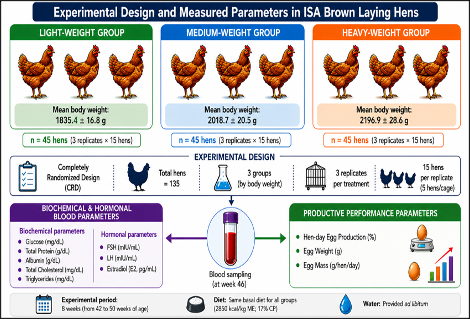
This study aimed to evaluate the physiological relationship between body weight, selected biochemical and hormonal serum parameters, and their association with productive performance in ISA Brown laying hens during the mid-laying period (42–50 weeks of age). A total of 135 ISA Brown laying hens were into three experimental groups according to body weight category: light, medium, and heavy body weight, with 45 hens per treatment. Productive performance traits, including hen-day egg production, egg weight, and egg mass, were recorded. In addition, serum concentrations of reproductive hormones (FSH, LH, and estradiol) and selected biochemical parameters, including glucose, total protein, albumin, cholesterol, and triglycerides, were determined.
The results demonstrated that medium-weight hens showed significantly higher (P ≤ 0.05) hen-day egg production and increased concentrations of reproductive hormones, total protein, and albumin compared with the other groups, indicating a more favorable physiological and metabolic balance associated with improved reproductive efficiency and laying persistency. In contrast, heavy-weight hens recorded significantly higher (P ≤ 0.05) egg weight, glucose, cholesterol, and triglyceride concentrations, reflecting increased metabolic activity and fat deposition associated with greater body weight. Pearson correlation analysis within body weight categories revealed significant positive correlations (P ≤ 0.05) between reproductive hormones and productive performance traits, particularly in medium-weight hens, whereas elevated cholesterol and triglyceride levels were negatively associated with some productive parameters.
In conclusion, maintaining moderate body weight in ISA Brown laying hens contributes to improved physiological balance and enhanced productive performance during the mid-laying period.
Downloads

Downloads
Published
Issue
Section
License
Copyright (c) 2026 Ahmed A. Al-Salhi (Author)

This work is licensed under a Creative Commons Attribution-NonCommercial 4.0 International License.