Efficacy of Neem (Azadirachta indica) and Cajuput (Melaleuca cajuputi) Leaf-Based Housing Sprays for Controlling Dermanyssus gallinae, Skin Lesions, and Irritation-Related Behaviors in Naturally Infested H’Mong Chickens
Keywords:
Azadirachta indica , botanical acaricide, Dermanyssus gallinae, H’Mong chickens, Melaleuca cajuputiAbstract
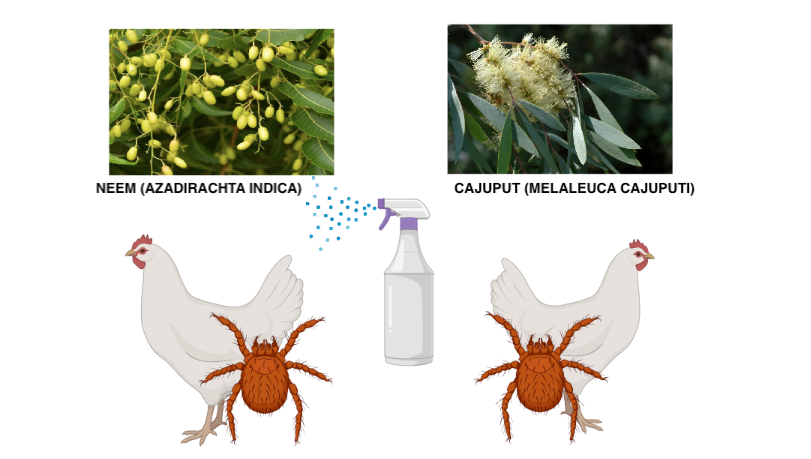
Dermanyssus gallinae persists mainly within poultry housing and repeatedly exposes chickens to blood feeding, cutaneous irritation, and behavioral disturbance. This study evaluated neem (Azadirachta indica) and cajuput (Melaleuca cajuputi) leaf-based housing sprays, applied individually and in combination, for controlling D. gallinae in naturally infested H’Mong chickens. Preliminary contact bioassays selected 7.5% (w/v) neem and 10.0% (w/v) cajuput for field application. A 42-day trial included 192 chickens allocated to 24 pens in a 2 × 2 factorial design with six pens per treatment. We sprayed housing surfaces on Days 0, 14, and 28, and repeatedly assessed mite abundance, skin lesions, feather damage, and daytime and nighttime behaviors. All botanical treatments suppressed mite populations relative to the vehicle control, with the combined formulation producing the greatest overall reduction. Henderson–Tilton efficacy of neem + cajuput reached 92.3% on Day 35 and remained 88.2% on Day 42, compared with 74.1% for neem and 52.3% for cajuput at the final assessment. By Day 42, skin lesion scores were 1.68 ± 0.07 in controls and 0.48 ± 0.07 with the combined treatment, while moderate-to-severe skin lesions occurred in 62.5% and 12.5% of chickens, respectively. Feather damage was also lowest with the combined formulation. Treatment effects on behavior were more evident at night; by Day 42, scratching was lower in all botanical groups, while nighttime activity was 16.0 ± 2.4% of scans in the combined group compared with 51.6 ± 4.0% in controls. Although the combined formulation produced the greatest overall suppression, this numerical advantage should not be interpreted as evidence of synergism. Repeated botanical housing treatments reduced D. gallinae pressure. They were accompanied by improved integumentary condition and fewer nighttime irritation-related responses, supporting their potential role in integrated poultry red mite management.
Downloads
References
Abdel-Ghaffar, F., Sobhy, H. M., Al-Quraishy, S., & Semmler, M. (2008). Field study on the efficacy of an extract of neem seed (Mite-Stop®) against the red mite Dermanyssus gallinae naturally infecting poultry in Egypt. Parasitology Research, 103(3), 481–485. https://doi.org/10.1007/s00436-008-0965-9
Abbott, W. S. (1925). A method of computing the effectiveness of an insecticide. Journal of Economic Entomology, 18(2), 265–267. https://doi.org/10.1093/jee/18.2.265a
Abouhosseini Tabari, M., Rostami, A., Khodashenas, A., Maggi, F., Petrelli, R., Giordani, C., Tapondjou, L. A., Papa, F., Zuo, Y., Cianfaglione, K., & Youssefi, M. R. (2020). Acaricidal activity, mode of action, and persistent efficacy of selected essential oils on the poultry red mite (Dermanyssus gallinae). Food and Chemical Toxicology, 138, 111207. https://doi.org/10.1016/j.fct.2020.111207
Cafiero, M. A., Camarda, A., Circella, E., Raele, D., Giangaspero, A., & Sparagano, O. A. E. (2008). Dermanyssus gallinae prevalence in laying hen units in the Apulia Region, Italy. Proceedings of the British Society for Parasitology, 167, BSP048.
Camarda, A., Pugliese, N., Bevilacqua, A., Circella, E., Gradoni, L., George, D., Sparagano, O., & Giangaspero, A. (2018). Efficacy of a novel neem oil formulation (RP03™) to control the poultry red mite Dermanyssus gallinae. Medical and Veterinary Entomology, 32(3), 290–297. https://doi.org/10.1111/mve.12296
Chauve, C. (1998). The poultry red mite Dermanyssus gallinae (De Geer, 1778): Current situation and future prospects for control. Veterinary Parasitology, 79(3), 239–245. https://doi.org/10.1016/S0304-4017(98)00167-8
Chen, Z. Z., Deng, Y. X., Yin, Z. Q., Wei, Q., Li, M., Jia, R. Y., Xu, J., Li, L., Song, X., Liang, X. X., Shu, G., He, C. L., Gu, X. B., Lv, C., & Yin, L. (2014). Studies on the acaricidal mechanism of the active components from neem (Azadirachta indica) oil against Sarcoptes scabiei var. cuniculi. Veterinary Parasitology, 204(3–4), 323–329. https://doi.org/10.1016/j.vetpar.2014.05.040
Chirico, J., Eriksson, H., Fossum, O., & Jansson, D. (2003). The poultry red mite, Dermanyssus gallinae, a potential vector of Erysipelothrix rhusiopathiae causing erysipelas in hens. Medical and Veterinary Entomology, 17(2), 232–234. https://doi.org/10.1046/j.1365-2915.2003.00428.x
Decru, E., Mul, M., Nisbet, A. J., Vargas Navarro, A. H., Chiron, G., Walton, J., Norton, T., Roy, L., & Sleeckx, N. (2020). Possibilities for IPM strategies in European laying hen farms for improved control of the poultry red mite (Dermanyssus gallinae): Details and state of affairs. Frontiers in Veterinary Science, 7, 565866. https://doi.org/10.3389/fvets.2020.565866
Denardi, S. E., Bechara, G. H., de Oliveira, P. R., & Camargo-Mathias, M. I. (2011). Inhibitory action of neem aqueous extract (Azadirachta indica A. Juss) on the vitellogenesis of Rhipicephalus sanguineus (Latreille, 1806) (Acari: Ixodidae) ticks. Microscopy Research and Technique, 74(10), 889–899. https://doi.org/10.1002/jemt.20973
Di Palma, A., Giangaspero, A., Cafiero, M. A., & Germinara, G. S. (2012). A gallery of the key characters to ease identification of Dermanyssus gallinae (Acari: Gamasida: Dermanyssidae) and allow differentiation from Ornithonyssus sylviarum (Acari: Gamasida: Macronyssidae). Parasites & Vectors, 5, 104. https://doi.org/10.1186/1756-3305-5-104
EFSA Panel on Additives and Products or Substances used in Animal Feed (FEEDAP), Bampidis, V., Azimonti, G., Bastos, M. L., Christensen, H., Durjava, M., Kouba, M., López-Alonso, M., López Puente, S., Marcon, F., Mayo, B., Pechová, A., Petkova, M., Ramos, F., Villa, R. E., Woutersen, R., Chesson, A., Schlatter, J., Westendorf, J., Dirven, Y., Manini, P., & Dusemund, B. (2024). Safety and efficacy of a feed additive consisting of an essential oil derived from fresh leaves of Melaleuca cajuputi Maton & Sm. ex R. Powell and Melaleuca leucadendra (L.) L. (cajuput oil) for use in all animal species (FEFANA asbl). EFSA Journal, 22(4), e8732. https://doi.org/10.2903/j.efsa.2024.8732
George, D. R., Smith, T. J., Shiel, R. S., Sparagano, O. A. E., & Guy, J. H. (2009). Mode of action and variability in efficacy of plant essential oils showing toxicity against the poultry red mite, Dermanyssus gallinae. Veterinary Parasitology, 161(3–4), 276–282. https://doi.org/10.1016/j.vetpar.2009.01.010
Giglioti, R., Forim, M. R., Oliveira, H. N., Chagas, A. C. S., Ferrezini, J., Brito, L. G., Falcoski, T. O. R. S., Albuquerque, L. G., & Oliveira, M. C. S. (2011). In vitro acaricidal activity of neem (Azadirachta indica) seed extracts with known azadirachtin concentrations against Rhipicephalus microplus. Veterinary Parasitology, 181(2–4), 309–315. https://doi.org/10.1016/j.vetpar.2011.03.053
Isah, M., Sul’ain, M. D., Wan Abdul Wahab, W. N. A., Abdullah, H., Jamil, S., Syamira, N., Shabudin, M., Shuid, A. N., & Wan Ishak, W. R. (2025). Chemical profiling and mechanistic insights into the antibacterial efficacy of Melaleuca cajuputi leaf extract. BMC Complementary Medicine and Therapies, 25(1), 121. https://doi.org/10.1186/s12906-025-04790-5
Johnson, E. J., McComic, S. E., Rault, L. C., Swale, D. R., & Anderson, T. D. (2023). Bioinsecticidal activity of cajeput oil to pyrethroid-susceptible and -resistant mosquitoes. Pesticide Biochemistry and Physiology, 193, 105458. https://doi.org/10.1016/j.pestbp.2023.105458
Henderson, C. F., & Tilton, E. W. (1955). Tests with acaricides against the brown wheat mite. Journal of Economic Entomology, 48(2), 157–161. https://doi.org/10.1093/jee/48.2.157
Höglund, J., Nordenfors, H., & Uggla, A. (1995). Prevalence of the poultry red mite, Dermanyssus gallinae, in different types of production systems for egg layers in Sweden. Poultry Science, 74(11), 1793–1798. https://doi.org/10.3382/ps.0741793
Hobbenaghi, R., Tavassoli, M., Alimehr, M., Shokrpoor, S., & Ghorbanzadeghan, M. (2012). Histopathological study of the mite biting (Dermanyssus gallinae) in poultry skin. Veterinary Research Forum, 3(3), 205–208.
Hu, Z., Chen, Z., Yin, Z., Jia, R., Song, X., Li, L., Zou, Y., Liang, X., Li, L., He, C., Yin, L., Lv, C., Zhao, L., Su, G., Ye, G., & Shi, F. (2015). In vitro acaricidal activity of 1,8-cineole against Sarcoptes scabiei var. cuniculi and regulating effects on enzyme activity. Parasitology Research, 114(8), 2959–2967. https://doi.org/10.1007/s00436-015-4498-8
Kilpinen, O., Roepstorff, A., Permin, A., Nørgaard-Nielsen, G., Lawson, L. G., & Simonsen, H. B. (2005). Influence of Dermanyssus gallinae and Ascaridia galli infections on behaviour and health of laying hens (Gallus gallus domesticus). British Poultry Science, 46(1), 26–34. https://doi.org/10.1080/00071660400023839
Kim, S. I., Yi, J. H., Tak, J. H., & Ahn, Y. J. (2004). Acaricidal activity of plant essential oils against Dermanyssus gallinae (Acari: Dermanyssidae). Veterinary Parasitology, 120(4), 297–304. https://doi.org/10.1016/j.vetpar.2003.12.016
Kim, S. I., Na, Y. E., Yi, J. H., Kim, B. S., & Ahn, Y. J. (2007). Contact and fumigant toxicity of oriental medicinal plant extracts against Dermanyssus gallinae (Acari: Dermanyssidae). Veterinary Parasitology, 145(3–4), 377–382. https://doi.org/10.1016/j.vetpar.2006.12.021
Kumari, P., Kumar, S., Deo, A. D., Rajendran, K. V., & Raman, R. P. (2021). Antiparasitic potentiality of ethanol and methanol extracts of Azadirachta indica leaf for eggs and copepodid stage of Argulus japonicus: In vitro study. Journal of Parasitic Diseases, 45(3), 769–777. https://doi.org/10.1007/s12639-021-01355-4
Locher, N., Al-Rasheid, K. A. S., Abdel-Ghaffar, F., & Mehlhorn, H. (2010). In vitro and field studies on the contact and fumigant toxicity of a neem-product (Mite-Stop®) against the developmental stages of the poultry red mite Dermanyssus gallinae. Parasitology Research, 107(2), 417–423. https://doi.org/10.1007/s00436-010-1882-2
Mehnaz, S., Abbas, R. Z., Kanchev, K., Rafique, M. N., Aslam, M. A., Bilal, M., Ather, A. S., Zahid, A., & Batool, T. (2023). Natural control perspectives of Dermanyssus gallinae in poultry. International Journal of Agriculture and Biosciences, 12(3), 136–142. https://doi.org/10.47278/journal.ijab/2023.056
Mul, M. F., van Riel, J. W., Meerburg, B. G., Dicke, M., George, D. R., & Groot Koerkamp, P. W. G. (2015). Validation of an automated mite counter for Dermanyssus gallinae in experimental laying hen cages. Experimental and Applied Acarology, 66(4), 589–603. https://doi.org/10.1007/s10493-015-9923-2
Nordenfors, H., Höglund, J., & Uggla, A. (1999). Effects of temperature and humidity on oviposition, molting, and longevity of Dermanyssus gallinae (Acari: Dermanyssidae). Journal of Medical Entomology, 36(1), 68–72. https://doi.org/10.1093/jmedent/36.1.68
Nordenfors, H., & Chirico, J. (2001). Evaluation of a sampling trap for Dermanyssus gallinae (Acari: Dermanyssidae). Journal of Economic Entomology, 94(6), 1617–1621. https://doi.org/10.1603/0022-0493-94.6.1617
Petersen, I., Johannhörster, K., Pagot, E., Escribano, D., Zschiesche, E., Temple, D., & Thomas, E. (2021). Assessment of fluralaner as a treatment in controlling Dermanyssus gallinae infestation on commercial layer farms and the potential for resulting benefits of improved bird welfare and productivity. Parasites & Vectors, 14, 181. https://doi.org/10.1186/s13071-021-04685-7
Radsetoulalova, I., Hubert, J., Hampel, D., & Lichovnikova, M. (2020). Active components of essential oils as acaricides against Dermanyssus gallinae. British Poultry Science, 61(2), 169–172. https://doi.org/10.1080/00071668.2019.1704686
Ran, C., Zhang, Z., Zhang, S., Fan, J., Guo, Y., Wang, C., & Zuo, Y. (2025). In vitro acaricidal activity of spice essential oils against the poultry red mite (Dermanyssus gallinae). Poultry Science, 104(9), 105387. https://doi.org/10.1016/j.psj.2025.105387
Sadgrove, N., & Jones, G. (2015). A contemporary introduction to essential oils: Chemistry, bioactivity and prospects for Australian agriculture. Agriculture, 5(1), 48–102. https://doi.org/10.3390/agriculture5010048
Sakasegawa, M., Hori, K., & Yatagai, M. (2003). Composition and antitermite activities of essential oils from Melaleuca species. Journal of Wood Science, 49(2), 181–187. https://doi.org/10.1007/s100860300029
Schreiter, R., Herzog, M., & Freick, M. (2022). Effects of the poultry red mite (Dermanyssus gallinae) load on the plumage condition in commercial laying hen farms. PLOS ONE, 17(11), e0277513. https://doi.org/10.1371/journal.pone.0277513
Sikes, R. K., & Chamberlain, R. W. (1954). Laboratory observations on three species of bird mites. The Journal of Parasitology, 40(6), 691–697. https://doi.org/10.2307/3273713
Sparagano, O. A. E., George, D. R., Harrington, D. W. J., & Giangaspero, A. (2014). Significance and control of the poultry red mite, Dermanyssus gallinae. Annual Review of Entomology, 59, 447–466. https://doi.org/10.1146/annurev-ento-011613-162101
Sparagano, O. A. E., George, D. R., Finn, R. D., Giangaspero, A., Bartley, K., & Ho, J. (2020). Dermanyssus gallinae and chicken egg production: Impact, management, and a predicted compatibility matrix for integrated approaches. Experimental and Applied Acarology, 82, 441–453. https://doi.org/10.1007/s10493-020-00558-3
Takagi, M., Tachi, Y., Zhang, J., Shinozaki, T., Ishii, K., Kikuchi, T., Ukiya, M., Banno, N., Tokuda, H., & Akihisa, T. (2014). Cytotoxic and melanogenesis-inhibitory activities of limonoids from the leaves of Azadirachta indica (Neem). Chemistry & Biodiversity, 11(3), 451–468. https://doi.org/10.1002/cbdv.201300348
Temple, D., Manteca, X., Escribano, D., Salas, M., Mainau, E., Zschiesche, E., Petersen, I., Dolz, R., & Thomas, E. (2020). Assessment of laying-bird welfare following acaricidal treatment of a commercial flock naturally infested with the poultry red mite (Dermanyssus gallinae). PLOS ONE, 15(11), e0241608. https://doi.org/10.1371/journal.pone.0241608
Toan, T. Q., Thao, L. P. P., Chien, N. Q., Van, N. T. H., Phuong, D. L., Huong, T. T., Quan, P. M., An, C. T., Minh, P. T. H., Bich, H. T., Ngan, T. T. K., Thai, T. V., Viet, N. T., Bach, L. G., & Long, P. Q. (2020). Determination of chemical composition and antimicrobial activity of Melaleuca cajuputi essential oil from Quang Tri Province, Vietnam. Asian Journal of Chemistry, 32(9), 2203–2207. https://doi.org/10.14233/ajchem.2020.22458
Tran, D. B., Dargusch, P., Moss, P., & Hoang, T. V. (2013). An assessment of potential responses of Melaleuca genus to global climate change. Mitigation and Adaptation Strategies for Global Change, 18, 851–867. https://doi.org/10.1007/s11027-012-9394-2
Van, H. T., Phan, U. T. X., & Tran, G. B. (2019). Chemical diversity of the Melaleuca cajuputi leaf oils from six locations in southern Vietnam. Agriculturae Conspectus Scientificus, 84(4), 391–397.
Vui, N. V. & Quyen, N. T. K. (2025). Acaricidal effects of Melaleuca cajuputi essential oil on Rhipicephalus sanguineus ticks in dogs. Journal of Animal Health and Production, 13(2), 480–487. https://doi.org/10.17582/journal.jahp/2025/13.7.480.487
Zenner, L., Bon, G., Chauve, C., Nemoz, C., & Lubac, S. (2009). Monitoring of Dermanyssus gallinae in free-range poultry farms. Experimental and Applied Acarology, 48(1–2), 157–166. https://doi.org/10.1007/s10493-009-9253-3

Published
Issue
Section
License
Copyright (c) 2026 Phan Nhân, Nguyễn Thị Chúc (Author)

This work is licensed under a Creative Commons Attribution-NonCommercial 4.0 International License.