Association of Growth Hormone Secretagogue Receptor (GHSR) Gene Polymorphisms with Performance Traits in Four Chicken Genotypes
Abstract
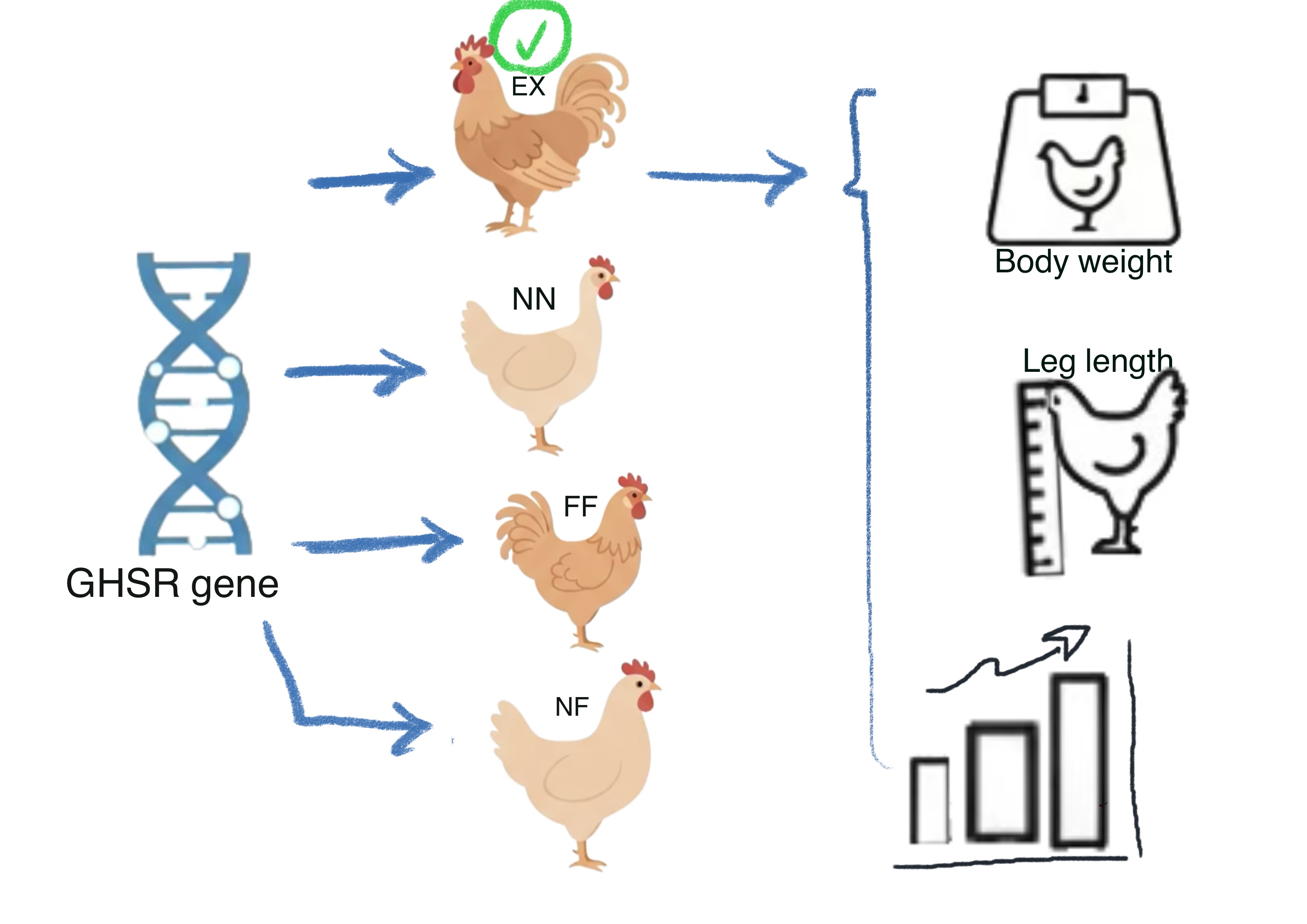
Poultry farming is crucial to global food security, with particular significance in developing nations due to its affordability, efficiency, and contribution to rural livelihoods. This study evaluated morphological traits and genetic polymorphisms in the growth hormone secretagogue receptor (GHSR) gene across four chicken genotypes: Normal Feather (NF), Frizzle Feather (FF), Naked Neck (NN), and Exotic (EX). A total of 100 day-old chicks were reared under controlled conditions, and growth performance traits, including body weight, height, body length, and shank length, were measured. Genomic DNA was extracted from blood samples, and the GHSR gene was amplified by Polymerase Chain Reaction (PCR). The resulting PCR products were sequenced and analyzed to identify genetic polymorphisms. The results showed that the EX genotype significantly outperformed the indigenous genotypes (NF, FF, and NN) in all growth parameters. The highest level of genetic variation was observed in the EX chickens, followed by FF, NF, and NN genotypes. The EX genotype also exhibited the highest haplotype diversity (0.946 ± 0.006), whereas the highest nucleotide diversity was recorded in NF chickens (0.131 ± 0.0001). Phylogenetic analysis revealed two distinct clusters, with all indigenous genotypes grouped within the same major cluster, while the EX genotype formed a separate cluster. The lowest genetic distance was observed between the FF and NN chickens. Single-nucleotide polymorphisms (SNPs) in the GHSR gene were significantly associated with body weight, body length, and shank length, particularly in the EX genotype (p<0.05). These findings suggest that SNP variation within the GHSR gene may serve as a useful basis for developing molecular markers to enhance growth performance, while also emphasizing the importance of maintaining genetic diversity in indigenous chicken populations.
Downloads

Downloads
Published
Issue
Section
License
Copyright (c) 2026 Jude Ngozichukwuka Efienokwu (Author); Ekerette Emmanuel Ekerette (Corresponding Author); Owoidihe Monday Etukudo, Lawrence Enyioha Okonko, Nkoyo Ani Nkang, Seyi Ebun Adeboye, Pass Chidiebere Chijindu, Ekei Victor Ikpeme (Author)

This work is licensed under a Creative Commons Attribution-NonCommercial 4.0 International License.