Next-Generation Feed Additives in Poultry Production: The Role of Encapsulation Technologies in Precision Nutrition
Keywords:
microencapsulation;, nanoemulsion; , controlled release; , poultry nutritionAbstract
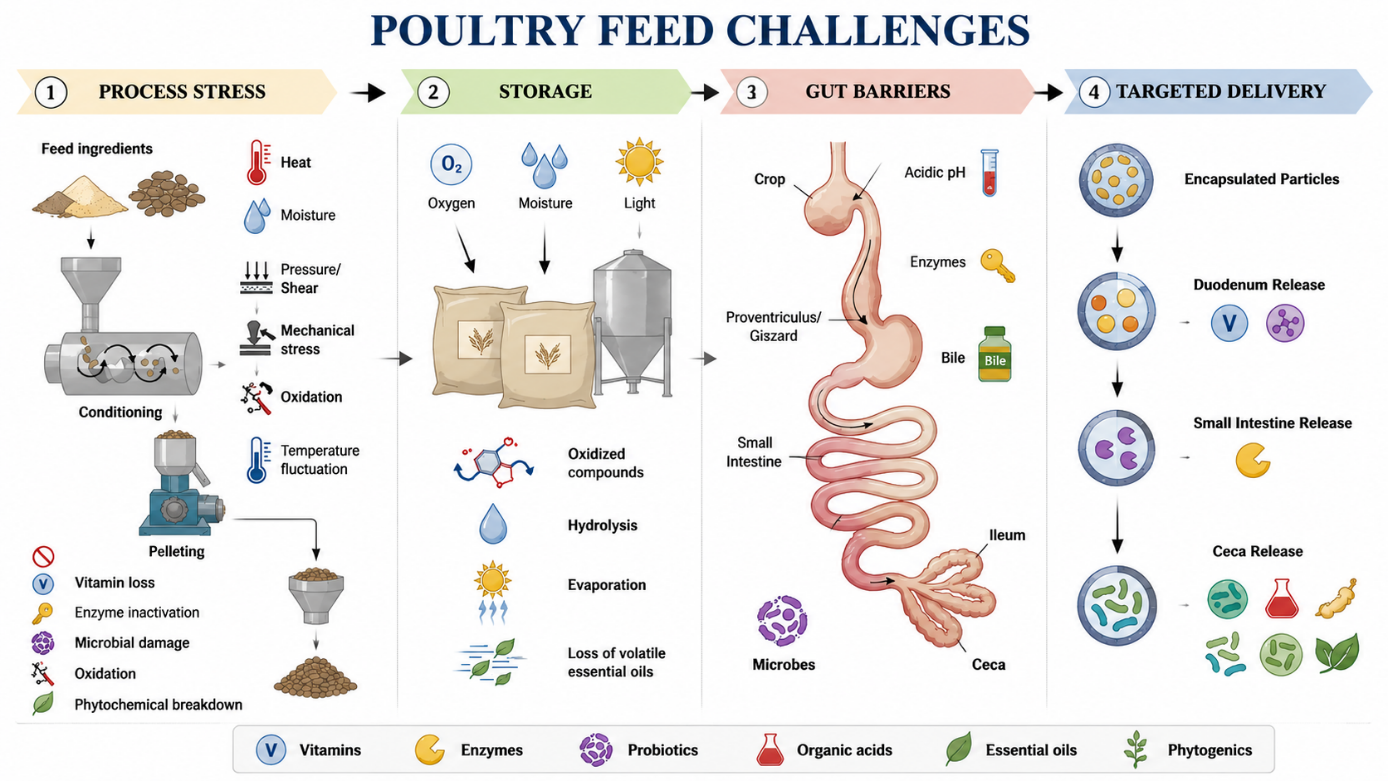
The poultry industry is increasingly seeking nutritional strategies that enhance productivity, support intestinal health, and reduce reliance on antibiotic growth promoters. However, many functional feed additives, including vitamins, organic acids, essential oils, probiotics, enzymes, and trace minerals, are susceptible to degradation during feed processing, storage, and gastrointestinal transit, which can limit their stability, bioavailability, and biological efficacy. Encapsulation technologies have emerged as effective delivery approaches to address these limitations by protecting bioactive compounds and enabling controlled or site-specific release within the digestive tract. This mini-review summarizes recent advances in encapsulation-based delivery systems for poultry nutrition, with emphasis on microencapsulation, nanoemulsions, spray-dried formulations, and controlled-release platforms. Available evidence suggests that encapsulated feed additives can improve nutrient stability, enhance intestinal availability, support epithelial barrier integrity, modulate gut microbiota, and contribute to improved growth performance and feed efficiency. Encapsulated phytogenics, organic acids, probiotics, enzymes, and nano-formulated minerals also show potential as components of antibiotic-reduction strategies in modern poultry production. Nevertheless, challenges related to manufacturing scalability, cost-effectiveness, regulatory approval, formulation standardization, and long-term safety remain important barriers to wider commercial adoption. Future research should focus on optimizing carrier materials, improving release precision, validating efficacy under commercial production conditions, and integrating encapsulation technologies with precision nutrition strategies. Overall, encapsulation represents a promising approach for improving the efficacy of functional feed additives and supporting sustainable poultry production in the post-antibiotic era
Downloads

Downloads
Published
Issue
Section
License
Copyright (c) 2026 Bahareh Saeed Abadi, Ebrahimi Soleiman Dehkordi (Author); Samad Nejad Ebrahimi (Corresponding Author)

This work is licensed under a Creative Commons Attribution-NonCommercial 4.0 International License.