Machine learning-driven identification of immune signatures from RNA-Seq data in H5N1-infected chickens: a computational Immunology approach
Keywords:
H5N1, RNA-Seq, Machine Learning (ML), Chicken immune response, Immunoinformatics.Abstract
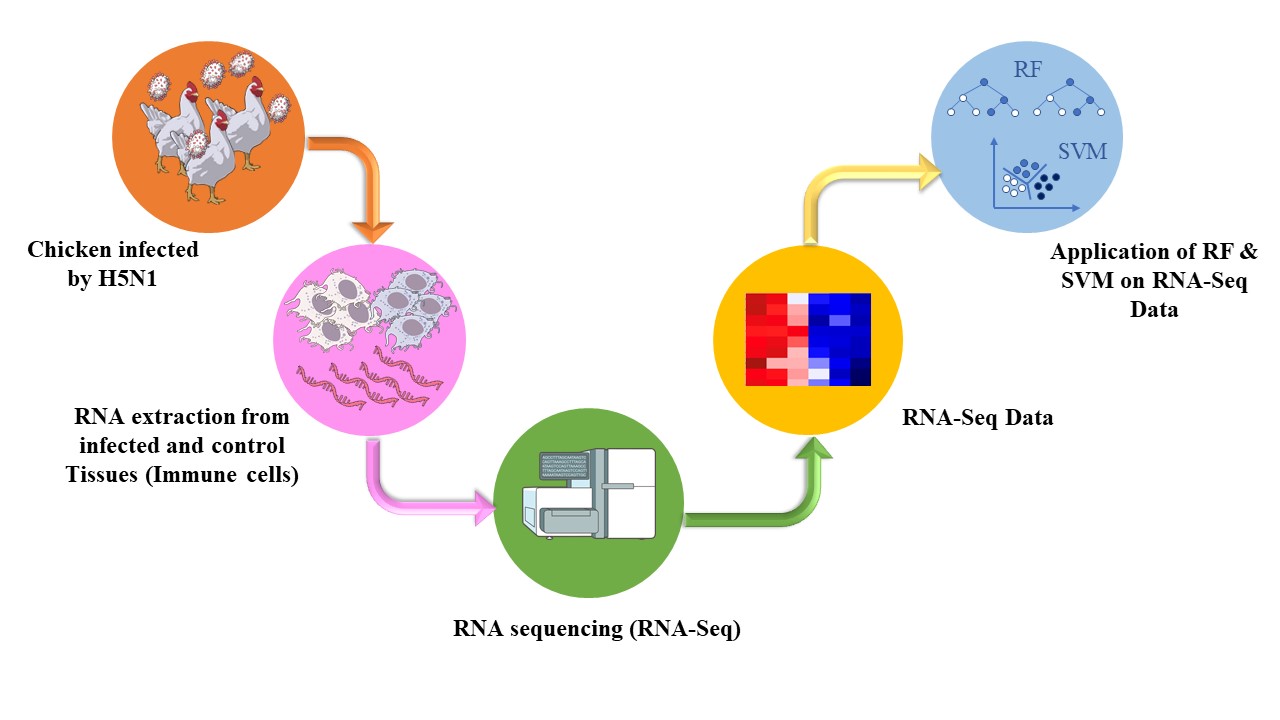
Highly Pathogenic Avian Influenza (H5N1) continues to pose a serious risk to public health and poultry. In order to differentiate H5N1-infected from healthy chicken samples and to guide the development of diagnostics and vaccines, we postulated that Machine Learning (ML) applied to RNA sequencing (RNA-Seq) data could biologically detect meaningful immune gene signatures. While previous transcriptomic studies have characterized host responses to H5N1 infection in chickens, the application of interpretable machine-learning approaches to prioritize immune-associated transcriptional signatures from chicken RNA-Seq datasets remains relatively unexplored. RNA-Seq data from H5N1-infected chicken lung and ileum tissues (ArrayExpress E-MTAB-2908) that were publicly available, were chosen. Fivefold stratified cross-validation (~80/20 train/test per fold) was used to train two supervised ML models, such as Random Forest (RF) and linear-kernel Support Vector Machine (SVM). Performance was evaluated using Area Under Curve (AUC) and Receiver Operating Characteristic (ROC) curves. RF reached a mean AUC=0.85, while SVM-Linear achieved AUC=0.75. Top-ranking interferon-stimulated genes (ISGs), including IFIT5, MX1, and OASL, were consistently upregulated in infected samples, indicating activation of type I interferon pathways. Concordant findings across models support the stability and biological relevance of the identified signatures despite the modest sample size. These findings demonstrate that interpretable ML approaches can successfully prioritize biologically relevant antiviral signatures from chicken RNA-Seq datasets. However, the identified signatures should be considered candidate computational immune signatures that require independent experimental validation before potential application in biomarker development, disease surveillance, or vaccine-related research.
Downloads
References
Ahmed, N., Ranaware, P. B., Mishra, A., Vijayakumar, P., Gandhale, P. N., Kumar, H., Kulkarni, D. D., & Raut, A. A. (2016). Genome Wide Host Gene Expression Analysis in Chicken Lungs Infected with Avian Influenza Viruses. Plos One, 11(4). https://doi.org/10.1371/journal.pone.0153671
Breiman, L. (2001). . Machine Learning, 45(1). https://doi.org/https://doi.org/10.1023/A:1010933404324
Bzhalava, Z., Tampuu, A., Bala, P., Vicente, R., & Dillner, J. (2018). Machine Learning for detection of viral sequences in human metagenomic datasets. BMC Bioinformatics, 19(1), 336. https://doi.org/10.1186/s12859-018-2340-x
Ching, T., Himmelstein, D. S., Beaulieu-Jones, B. K., Kalinin, A. A., Do, B. T., Way, G. P., Ferrero, E., Agapow, P. M., Zietz, M., Hoffman, M. M., Xie, W., Rosen, G. L., Lengerich, B. J., Israeli, J., Lanchantin, J., Woloszynek, S., Carpenter, A. E., Shrikumar, A., Xu, J., . . . Greene, C. S. (2018). Opportunities and obstacles for deep learning in biology and medicine. J R Soc Interface, 15(141). https://doi.org/10.1098/rsif.2017.0387
Conesa, A., Madrigal, P., Tarazona, S., Gomez-Cabrero, D., Cervera, A., McPherson, A., Szczesniak, M. W., Gaffney, D. J., Elo, L. L., Zhang, X., & Mortazavi, A. (2016). A survey of best practices for RNA-seq data analysis. Genome Biol, 17, 13. https://doi.org/10.1186/s13059-016-0881-8
CORTES, C., & VAPNIK, V. (1995). . Machine Leaming 20(3). https://doi.org/https://doi.org/10.1023/A:1022627411411
de la Fuente, A. (2010). From 'differential expression' to 'differential networking' - identification of dysfunctional regulatory networks in diseases. Trends Genet, 26(7), 326-333. https://doi.org/10.1016/j.tig.2010.05.001
Diaz-Uriarte, R., & Alvarez de Andres, S. (2006). Gene selection and classification of microarray data using random forest. BMC Bioinformatics, 7, 3. https://doi.org/10.1186/1471-2105-7-3
Ding, X., Ma, Y., Li, S., Liu, J., Qin, L., & Wu, A. (2025). Influenza virus reassortment patterns exhibit preference and continuity while uncovering cross-species transmission events. Brief Bioinform, 26(3). https://doi.org/10.1093/bib/bbaf233
Eraslan, G., Avsec, Z., Gagneur, J., & Theis, F. J. (2019). Deep learning: new computational modelling techniques for genomics. Nat Rev Genet, 20(7), 389-403. https://doi.org/10.1038/s41576-019-0122-6
Evseev, D., & Magor, K. E. (2019). Innate Immune Responses to Avian Influenza Viruses in Ducks and Chickens. Vet Sci, 6(1). https://doi.org/10.3390/vetsci6010005
Fawcett, T. (2006). An introduction to ROC analysis. Pattern Recognition Letters, 27(8), 861-874. https://doi.org/10.1016/j.patrec.2005.10.010
Ge, S., Sun, S., Xu, H., Cheng, Q., & Ren, Z. (2025). Deep learning in single-cell and spatial transcriptomics data analysis: advances and challenges from a data science perspective. Brief Bioinform, 26(2). https://doi.org/10.1093/bib/bbaf136
Geoffrey S Ginsburg, S. B. H. (2006). . Expert Review of Molecular Diagnostics, 6(2). https://doi.org/https://doi.org/10.1586/14737159.6.2.179
Giotis, E. S., Robey, R. C., Skinner, N. G., Tomlinson, C. D., Goodbourn, S., & Skinner, M. A. (2016). Chicken interferome: avian interferon-stimulated genes identified by microarray and RNA-seq of primary chick embryo fibroblasts treated with a chicken type I interferon (IFN-alpha). Vet Res, 47(1), 75. https://doi.org/10.1186/s13567-016-0363-8
Golpasand, S., Ghovvati, S., & Pezeshkian, Z. (2025). Exploring the molecular and biological mechanisms of host response in chickens infected with highly pathogenic avian influenza virus (H5N1): An integrative transcriptomic analysis. PLoS One, 20(10), e0332689. https://doi.org/10.1371/journal.pone.0332689
Hassan, M. S. H., & Sharif, S. (2025). Immune responses to avian influenza viruses in chickens. Virology, 603, 110405. https://doi.org/10.1016/j.virol.2025.110405
He, X., Zhang, S., Zou, Z., Gao, P., Yang, L., & Xiang, B. (2024). Antiviral Effects of Avian Interferon-Stimulated Genes. Animals, 14(21). https://doi.org/10.3390/ani14213062
Huang, S., Chaudhary, K., & Garmire, L. X. (2017). More Is Better: Recent Progress in Multi-Omics Data Integration Methods. Front Genet, 8, 84. https://doi.org/10.3389/fgene.2017.00084
Hwang, H., Jeon, H., Yeo, N., & Baek, D. (2024). Big data and deep learning for RNA biology. Exp Mol Med, 56(6), 1293-1321. https://doi.org/10.1038/s12276-024-01243-w
Karczewski, K. J., & Snyder, M. P. (2018). Integrative omics for health and disease. Nat Rev Genet, 19(5), 299-310. https://doi.org/10.1038/nrg.2018.4
Krstajic, D., Buturovic, L. J., Leahy, D. E., & Thomas, S. (2014). Cross-validation pitfalls when selecting and assessing regression and classification models. J Cheminform, 6(1), 10. https://doi.org/10.1186/1758-2946-6-10
Kuchipudi, S. V., Dunham, S. P., & Chang, K. C. (2015). DNA microarray global gene expression analysis of influenza virus-infected chicken and duck cells. Genom Data, 4, 60-64. https://doi.org/10.1016/j.gdata.2015.03.004
Li, R., Li, L., Xu, Y., & Yang, J. . (2022). . Briefings in Bioinformatics 23(1). https://doi.org/10.1093/bib/bbab460
Libbrecht, M. W., & Noble, W. S. (2015). Machine learning applications in genetics and genomics. Nat Rev Genet, 16(6), 321-332. https://doi.org/10.1038/nrg3920
Liniger, M., Summerfield, A., Zimmer, G., McCullough, K. C., & Ruggli, N. (2012). Chicken Cells Sense Influenza A Virus Infection through MDA5 and CARDIF Signaling Involving LGP2. Journal of Virology, 86(2), 705-717. https://doi.org/10.1128/jvi.00742-11
Love, M. I., Huber, W., & Anders, S. (2014). Moderated estimation of fold change and dispersion for RNA-seq data with DESeq2. Genome Biol, 15(12), 550. https://doi.org/10.1186/s13059-014-0550-8
Lowe, R., Shirley, N., Bleackley, M., Dolan, S., & Shafee, T. (2017). Transcriptomics technologies. PLoS Comput Biol, 13(5), e1005457. https://doi.org/10.1371/journal.pcbi.1005457
Mckinney, W. (2010). . Proceedings of the 9th Python in Science Conference. https://doi.org/https://doi.org/10.25080/Majora-92bf1922-00a
Morris, K. M., Mishra, A., Raut, A. A., Gaunt, E. R., Borowska, D., Kuo, R. I., Wang, B., Vijayakumar, P., Chingtham, S., Dutta, R., Baillie, K., Digard, P., Vervelde, L., Burt, D. W., & Smith, J. (2023). The molecular basis of differential host responses to avian influenza viruses in avian species with differing susceptibility. Front Cell Infect Microbiol, 13, 1067993. https://doi.org/10.3389/fcimb.2023.1067993
Noble, W. S. (2006). . NATURE BIOTECHNOLOGY, 24(12). https://doi.org/https://doi.org/10.1038/nbt1206-1565.
Overmyer, K. A., Shishkova, E., Miller, I. J., Balnis, J., Bernstein, M. N., Peters-Clarke, T. M., Meyer, J. G., Quan, Q., Muehlbauer, L. K., Trujillo, E. A., He, Y., Chopra, A., Chieng, H. C., Tiwari, A., Judson, M. A., Paulson, B., Brademan, D. R., Zhu, Y., Serrano, L. R., . . . Jaitovich, A. (2021). Large-Scale Multi-omic Analysis of COVID-19 Severity. Cell Syst, 12(1), 23-40 e27. https://doi.org/10.1016/j.cels.2020.10.003
Pedregosa, F., Varoquaux, G., Gramfort, A., Michel, V., Thirion, B., Grisel, O.,. (2011). . Journal of machine learning research, 12. https://doi.org/http://arxiv.org/abs/1201.0490
Perrone, L. A., Plowden, J. K., Garcia-Sastre, A., Katz, J. M., & Tumpey, T. M. (2008). H5N1 and 1918 pandemic influenza virus infection results in early and excessive infiltration of macrophages and neutrophils in the lungs of mice. PLoS Pathog, 4(8), e1000115. https://doi.org/10.1371/journal.ppat.1000115
Pichlmair, A., Lassnig, C., Eberle, C. A., Gorna, M. W., Baumann, C. L., Burkard, T. R., Burckstummer, T., Stefanovic, A., Krieger, S., Bennett, K. L., Rulicke, T., Weber, F., Colinge, J., Muller, M., & Superti-Furga, G. (2011). IFIT1 is an antiviral protein that recognizes 5'-triphosphate RNA. Nat Immunol, 12(7), 624-630. https://doi.org/10.1038/ni.2048
Raeven, R. H. M., van Riet, E., Meiring, H. D., Metz, B., & Kersten, G. F. A. (2019). Systems vaccinology and big data in the vaccine development chain. Immunology, 156(1), 33-46. https://doi.org/10.1111/imm.13012
Randhawa, G. S., Soltysiak, M. P. M., El Roz, H., de Souza, C. P. E., Hill, K. A., & Kari, L. (2020). Machine learning using intrinsic genomic signatures for rapid classification of novel pathogens: COVID-19 case study. Plos One, 15(4), e0232391. https://doi.org/10.1371/journal.pone.0232391
Reel, P. S., Reel, S., Pearson, E., Trucco, E., & Jefferson, E. (2021). Using machine learning approaches for multi-omics data analysis: A review. Biotechnol Adv, 49, 107739. https://doi.org/10.1016/j.biotechadv.2021.107739
Rehman, S., Effendi, M. H., Witaningruma, A. M., Nnabuikeb, U. E., Bilal, M., Abbas, A., Abbas, R. Z., & Hussain, K. (2022). Avian influenza (H5N1) virus, epidemiology and its effects on backyard poultry in Indonesia: a review. F1000Res, 11, 1321. https://doi.org/10.12688/f1000research.125878.2
Ringnér, M. (2008). . NATURE BIOTECHNOLOGY 26. https://doi.org/https://doi.org/10.1038/nbt0308-303
Robinson, M. D., McCarthy, D. J., & Smyth, G. K. (2010). edgeR: a Bioconductor package for differential expression analysis of digital gene expression data. Bioinformatics, 26(1), 139-140. https://doi.org/10.1093/bioinformatics/btp616
Sadler, A. J., & Williams, B. R. (2008). Interferon-inducible antiviral effectors. Nat Rev Immunol, 8(7), 559-568. https://doi.org/10.1038/nri2314
Shu, L., Zhao, Y., Kurt, Z., Byars, S. G., Tukiainen, T., Kettunen, J., Orozco, L. D., Pellegrini, M., Lusis, A. J., Ripatti, S., Zhang, B., Inouye, M., Makinen, V. P., & Yang, X. (2016). Mergeomics: multidimensional data integration to identify pathogenic perturbations to biological systems. BMC Genomics, 17(1), 874. https://doi.org/10.1186/s12864-016-3198-9
Smith, J., Smith, N., Yu, L., Paton, I. R., Gutowska, M. W., Forrest, H. L., Danner, A. F., Seiler, J. P., Digard, P., Webster, R. G., & Burt, D. W. (2015). A comparative analysis of host responses to avian influenza infection in ducks and chickens highlights a role for the interferon-induced transmembrane proteins in viral resistance. BMC Genomics, 16(1), 574. https://doi.org/10.1186/s12864-015-1778-8
Stark, R., Grzelak, M., & Hadfield, J. (2019). RNA sequencing: the teenage years. Nat Rev Genet, 20(11), 631-656. https://doi.org/10.1038/s41576-019-0150-2
Statnikov, A., Aliferis, C. F., Tsamardinos, I., Hardin, D., & Levy, S. (2005). A comprehensive evaluation of multicategory classification methods for microarray gene expression cancer diagnosis. Bioinformatics, 21(5), 631-643. https://doi.org/10.1093/bioinformatics/bti033
Swayne, D. E. (2012). Impact of vaccines and vaccination on global control of avian influenza. Avian Dis, 56(4 Suppl), 818-828. https://doi.org/10.1637/10183-041012-Review.1
Tarca, A. L., Carey, V. J., Chen, X. wen, Romero, R., & Drǎghici, S. . (2007). . PLoS computational biology 3(6). https://doi.org/10.1371/journal.pcbi.0030116
Toussaint, P. A., Leiser, F., Thiebes, S., Schlesner, M., Brors, B., & Sunyaev, A. (2023). Explainable artificial intelligence for omics data: a systematic mapping study. Brief Bioinform, 25(1). https://doi.org/10.1093/bib/bbad453
Vu, T. H., Hong, Y., Truong, A. D., Lee, S., Heo, J., Lillehoj, H. S., & Hong, Y. H. (2022). The highly pathogenic H5N1 avian influenza virus induces the mitogen-activated protein kinase signaling pathway in the trachea of two Ri chicken lines. Anim Biosci, 35(7), 964-974. https://doi.org/10.5713/ab.21.0420
Wang, Z., Gerstein, M., & Snyder, M. (2009). RNA-Seq: a revolutionary tool for transcriptomics. Nat Rev Genet, 10(1), 57-63. https://doi.org/10.1038/nrg2484
Westermann, A. J., Barquist, L., & Vogel, J. (2017). Resolving host-pathogen interactions by dual RNA-seq. PLoS Pathog, 13(2), e1006033. https://doi.org/10.1371/journal.ppat.1006033

Downloads
Published
Issue
Section
License
Copyright (c) 2026 Fatemeh Keivan (Author); Gholamreza Nikbakht Brujeni (Corresponding Author)

This work is licensed under a Creative Commons Attribution-NonCommercial 4.0 International License.